For years, leaders were rewarded for knowledge. Who knew more. Who worked harder. Who had the most technical expertise. But we are entering a different era.
AI is rapidly changing how businesses operate. Information is now accessible in seconds. Processes are being automated. Technical capabilities that once took years to develop are becoming easier to replicate. The advantage is no longer information alone. The advantage is becoming deeply human and become master of influence and great relationships.
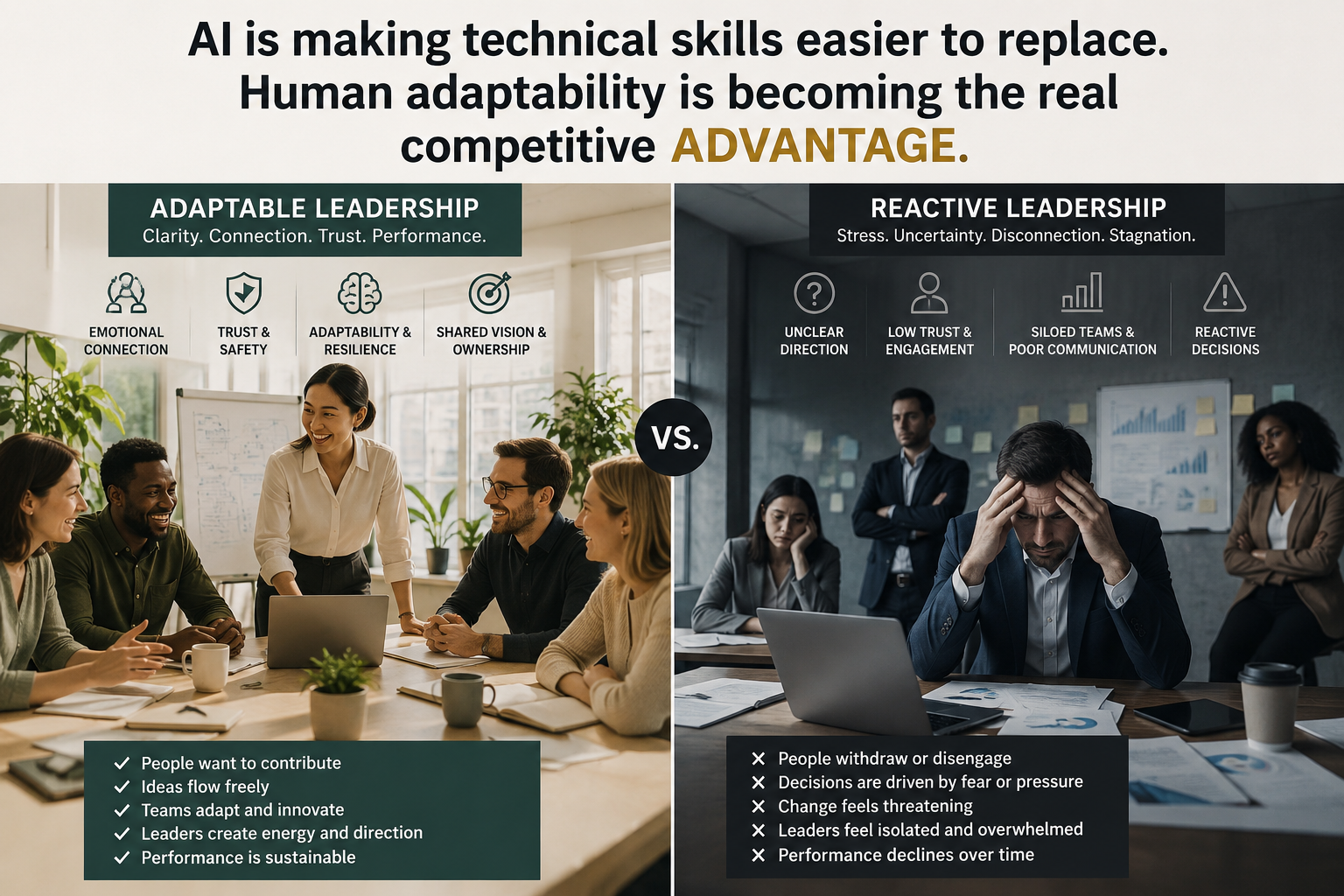
The leaders who will thrive in the next decade will not necessarily be the smartest people in the room. They will be the most adaptable, flexible, emotionally regulated, strategically clear, and behaviourally aware. Because while AI can automate tasks, it cannot replace human presence, emotional intelligence, trust, adaptability, intuition, or influential leadership.
And this is where leadership performance begins to change.
The real leadership crisis is not technology. It is human reactivity.
Most leaders are not struggling because they lack intelligence. They are struggling because their nervous system is overloaded. Under pressure, the brain shifts into survival mode. The body prioritises certainty, short-term safety, and immediate relief over long-term thinking and intentional behaviour.
This is why many intelligent leaders:
- become reactive under pressure
- avoid difficult conversations
- stay stuck in operational thinking
- struggle to adapt or make decisions during uncertainty
- default to emotional habits and subconscious behaviours
- seek short-term comfort instead of long-term growth
The challenge is not capability. The challenge is unconscious behavioural conditioning. And in a world changing this quickly, unconscious behaviour becomes expensive.
Human adaptability is becoming a leadership superpower
The future belongs to leaders who can:
- regulate emotions under pressure
- think strategically during uncertainty
- adapt quickly without losing themselves
- lead human connection in increasingly digital environments
- communicate with clarity and emotional intelligence
- stay grounded while navigating complexity and rapid change
These are not “soft skills.” They are high-performance leadership capabilities. And neuroscience now shows that emotional regulation, cognitive flexibility, and behavioural awareness directly impact decision-making, communication, resilience, creativity, and team performance.
The nervous system of a leader shapes the emotional environment of the entire organisation. Reactive leaders create reactive cultures. Regulated leaders create psychological safety, adaptability, trust, and higher-performing teams.
One of the biggest shifts I see in leadership today is this:
People know what to do, but they are not doing it consistently.
They know they should:
- prioritise health
- communicate more openly
- lead more intentionally
- stop operating in constant stress
- create boundaries
- think long-term
But knowledge alone does not create behavioural change.
Subconscious emotional patterns often drive our decisions more than logic.
Many daily behaviours are still unconsciously guided by:
- short-term pleasure
- emotional avoidance
- fear of uncertainty
- need for control
- comfort and familiarity
The brain naturally moves away from pain and towards immediate reward. But long-term leadership performance requires something different. It requires the ability to tolerate temporary discomfort in exchange for long-term growth, health, clarity, and meaningful results.
This is where conscious leadership begins.
Through our Neuro-Identity Shift Method, we explore how thoughts, emotions, behaviours, physiology, and identity patterns interact to shape leadership performance and quality of life.
Real transformation does not happen through motivation alone. It happens when leaders become aware of the subconscious patterns driving their behaviours and begin creating intentional behavioural alignment between:
- who they are today
- who they want to become
- and how they consistently show up under pressure
Because identity shapes behaviour. And behaviour shapes results.
When leaders strengthen emotional fitness, nervous system regulation, and behavioural awareness, they improve:
- strategic clarity
- adaptability
- resilience
- communication
- leadership presence
- decision-making
- long-term performance
The future will not belong only to those with the highest technical expertise. It will belong to those who can:
- adapt
- connect
- regulate themselves
- think clearly and make good decisions under pressure
- lead people effectively
- build trust
- navigate uncertainty
- and remain deeply human in increasingly automated environments
This is the human advantage.
And the leaders who develop these capabilities early will not only perform better professionally, they will create healthier teams, stronger cultures, better decisions, and more sustainable success.
The future of leadership is not less human. It is more human than ever.
Alex Terrey